

- September 16, 2026
Australian Group Insurance Market Underwriting Cycle, 15-years in the making
A strategy for international investors and reinsurers
September-2026
The Australian group life insurance market is globally unique, underpinned by a retirement savings system found nowhere else. The opportunity to win service-provider mandates worth tens or hundreds of millions of dollars in annual premium is enticing, but it arrives with a commensurate quantum of risk. This note sets out the cyclical nature of the group life market, the levers that drive its cyclicality, and the considerations for international capital assessing an entry.
The Australian Group Life Market
A sustainable premium source
- Legislated inflows. Premiums are deducted from tax-advantaged superannuation accounts that receive a compulsory inflow of at least 12% of each member’s salary.
- Default, opt-out cover. MySuper default products must offer death and disability cover on an opt-out basis. Cover attaches automatically once a member turns 25 and their account balance exceeds $6,000.
- Scale of the premium pool. The average annual premium for a default 40-year-old member is approximately $430 (0.5% of average gross salary).
Fund consolidation
- A larger pie, fewer plates. Superannuation assets have grown from $1.23 trillion in 2010 to $4.77 trillion in 2026 (not inflation adjusted), while the number of large funds has fallen sharply.
- Mandate concentration. A single mega-fund insurance mandate can materially change an insurer’s position in the market—one factor behind aggressively competitive terms, such as extended rate guarantees.
Insurers and reinsurers
- A five-insurer market. Only five insurers underwrite large group life mandates: TAL, AIA, Zurich, MetLife and Acenda.
- The reinsurance layer. A panel of reinsurers supports these insurers and participate heavily in group tenders, supporting pricing and historically taking substantial quota share arrangements.
Products
- Death. A lump-sum benefit on the death of the life insured, familiar across all developed insurance markets.
- Total and Permanent Disability (TPD). A lump-sum benefit payable when the life insured becomes permanently disabled under the policy definition—broadly, that they are unlikely ever to work again in any occupation (or, in some designs, their own occupation) due to illness or injury. The product has few true international analogues.
- Income Protection. A series of payments, typically 75% of usual salary, continuing for the shorter of the period of disability and the maximum benefit period.
The Underwriting Cycle
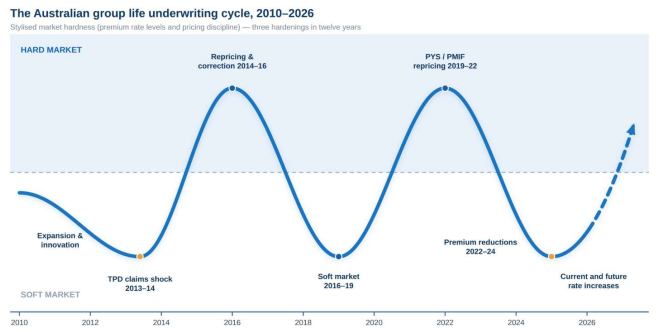
Pre-2013 | Expansion. The superannuation industry expanded rapidly, and insurers deployed capital in pursuit of larger mandates and product innovation.
2013–14 | TPD claims shock. Long notification delays on TPD claims, lawyer-assisted claim lodgement and liberal TPD definitions crystallised into considerable losses for insurers and their reinsurers.
2014–16 | Repricing and correction. Sweeping premium increases across group disability insurance, accompanied by tighter TPD definitions, restored discipline to the market.
2016–19 | The market softens. Competition intensified between insurers for fewer, larger contracts and premium rates fell again. Profit-sharing arrangements became common features of large-fund mandates.
2019–22 | Regulation triggers repricing. The Protecting Your Super (PYS) and Putting Members’ Interests First (PMIF) reforms carved out considerable membership and forced widespread repricing exercises. This gave insurers the opportunity to reprice on their terms, hardening the market.
2022–24 | Profitability restored. Following the PYS/PMIF repricing, the industry returned to profitability across death and disability cover. Large funds received reduced premium rates for consecutive years, and most now hold profit-sharing arrangements that build their own insurance reserves.
2025–current | Rate discounts meet mental health claims. TPD claims are approaching a crisis, with widespread deterioration driven by an influx of mental health claims. The pressure is compounded by the strong premium discounts handed out in preceding years by insurers chasing market share in a consolidating sector: acquire or be acquired.
Key Cycle Mechanics
The group life cycle is shaped by a collection of structural mechanics that make this market unlike any other globally.
- Institutional counterparties. The contract is not between policyholder and insurer. Policies are held by large, sophisticated institutions with strong negotiating capacity—shifting power away from insurers on terms and pricing.
- Mandate size drives retention behaviour. The sheer scale of each contract means insurers will go to great lengths to retain clients.
- Data lags amplify the cycle. Long development periods on disability claims create data lags in experience-based pricing. Long-tailed TPD results produce higher peaks and deeper troughs, as delayed experience compounds gains and losses.
- Active regulator. Regulatory change can rapidly impact who can be automatically insured and how those products are structured.
- The affordability ceiling. Premiums must not inappropriately erode retirement balances. When claims costs rise, the adjustment often falls on the sum insured rather than the rate.
Where the Cycle Sits Today
On current market trends, the group life market is in early hardening. Premium rate increases have flowed through some of the market, and mandates currently protected by rate guarantees are likely to face increases in the coming years. Three observations sharpen the picture:
- Claims development is not finished: TPD claims, mental health claims especially, will continue to develop over time.
- Capital wants its money back: Parent companies of insurers and reinsurers will be seeking future profits to recover past and current losses.
- Locked-in losses: Many insurers remain locked into unprofitable mandates through generous rate guarantees.
Considerations for Reinsurers Entering the Australian Market
The central tension in a cyclical market is balancing capital flexibility with relationship management. It may be economically optimal to enter and exit in line with the cycle—but the lunch and the handshake remain pivotal to winning insurance mandates in Australia.
Timing matters: The most attractive entry points support mandates where product terms are tightening within a hardening market—the position the market occupies today. For international organisations, Australian mortality and morbidity risk (and, in future, longevity) can also provide genuine diversification to a global portfolio.
- Capital injection: The volume of capital required is large: mandates can exceed $100 million in annual premium, and the full liability onboards on a single date. Capital must be committed all at once, with a meaningful lock-up period.
- Diversification benefit: Australian life risk is lowly correlated with most global portfolios’ existing exposures.
- Profitability: Entry economics must be assessed against the cycle position, rate guarantee tails and claims development risk.
- Local expertise: Actuaries at local insurers are experts in the Australian life risk market. They will look to a reinsurer for more complex support that draws on international experience; pricing support is a standard service provision by the reinsurer.
- Australian capital regulation: The Australian Prudential Regulation Authority (APRA) sets capital charges spanning insurance risk, asset concentration risk and more.
Azuria Partners can Support your Australian Market Assessment Needs
Azuria Partners is a boutique advisory firm specialising in Australia’s group life insurance and superannuation market. Our team brings expertise across life, disability, and retirement insurance in Australia, giving international entrants a clear view of how to structure, price, and scale a successful entry into this market. We combine technical actuarial insights with industry and regulatory knowledge, positioning Azuria as a trusted partner for organisations seeking to establish or grow their presence in this sector.


Damian Thornley
FIAA, PartnerDamian is Partner and Co-Founder of Azuria Partners, a team of actuarial consultants specialising in all areas of life insurance.
A qualified actuary with 25+ years’ experience, Damian has been the Head of Pricing (Group Insurance) for several life insurers and has a deep experience of life insurance product and pricing within the group insurance segment.
Damian has worked on tender pricing and product development for all major Superannuation funds in the Australian life insurance market. He has assisted Life Insurers and Reinsurers advising on major reinsurance transactions and portfolio evaluations / acquisitions.

Ethan Field
AIAA, CERA, Associate ActuaryEthan is an Associate Actuary at Azuria Partners. He is an Associate of the Institute of Actuaries and a Chartered Enterprise Risk Actuary; he has also attained a Bachelor degree of Actuarial Studies and Applied Finance from Macquarie University.
He has experience pricing group life and disability risk. He also has experience in product and pricing implementation for superannuation funds and large reinsurance balance sheet transactions.

Damian Thornley
FIAA, Partner
Damian is a Partner and Co-Founder of Azuria Partners, a team of actuarial consultants specialising in all areas of life insurance.
A qualified actuary with 25+ years’ experience, Damian has been the Head of Pricing (Group Insurance) for several life insurers and has a deep experience of life insurance product and pricing within the group insurance segment.
Damian has worked on tender pricing and product development for all major Superannuation funds in the Australian life insurance market. He has assisted Life Insurers and Reinsurers advising on major reinsurance transactions and portfolio evaluations / acquisitions.

Ethan Field
AIAA, CERA, Associate Actuary
Ethan is an Associate Actuary at Azuria Partners. He is an Associate of the Institute of Actuaries and a Chartered Enterprise Risk Actuary; he has also attained a Bachelor degree of Actuarial Studies and Applied Finance from Macquarie University.
He has experience pricing group life and disability risk. He also has experience in product and pricing implementation for superannuation funds and large reinsurance balance sheet transactions.